Luxury Real Estate Marketing Agency: What to Look For
Six things to check before hiring a luxury real estate marketing agency: ownership, published pricing, verifiable performance, and who is actually accountable for the compliance surfaces.
Before you hire a luxury real estate marketing agency, get straight answers to six questions: Do you own the site, the domain, and the leads on day one? Is the pricing published? Can you verify their performance claims yourself? Do they review Fair Housing and your state’s advertising rules before launch? Can a boutique brokerage actually out-market a national franchise? And what does the partner run every month beyond the website? The answers separate a real partner from a rented template.
The luxury marketing category is real and well funded. One vendor in it recently crossed $100M in annual recurring revenue serving agents and brokerages, which tells you the willingness to pay for done-for-you marketing is proven, not speculative. That also means the field is crowded with platforms that look similar and lock in differently. Here is how to tell them apart.
1. Do you own the site, the domain, and the leads on day one?
This is the question that decides all the others. Many real estate platforms rent you a site that stops the day you stop paying, hold your domain and your CRM inside their account, and keep the lead data as their asset. The marketing looks like everyone else’s on the same platform, and the buyers you paid to attract get handed back to the portals the moment they click through.
Ownership inverts that. You hold the domain, the codebase, the CRM, and the lead records from the first day, so switching vendors is a business decision, not a hostage negotiation. Ask any prospective partner one thing: if we part ways in a year, what do we walk away with? If the honest answer is a login that stops working, keep looking.
See where your current site leaks buyers back to the portals.
Get the free guide →2. Is the pricing published, or do you have to “get on a call”?
Published pricing is a proxy for how a vendor treats you. A firm that posts its build cost and monthly fee is telling you the number is the same for everyone and does not move based on how the discovery call goes. A firm that gates every price behind a sales call is usually pricing to the prospect, not to the work. You do not have to guess which one you are dealing with. If the cost is not on the site, that is the answer.
3. Can you verify their performance claims yourself?
Every agency will show you a fast, beautiful site. Ask to check it. Open Google’s PageSpeed Insights, paste in a site the agency built, and read the scores yourself, and weight mobile heavily, because that is where most buyer traffic lands. A screenshot in a pitch deck is a claim. A live score you ran in a free tool is evidence.
The same rule applies to structured data, accessibility, and SEO hygiene. These are all checkable in public tools. A partner worth hiring points you toward the checks, not away from them, and hands you the URL to run the numbers yourself. Treat any metric you cannot reproduce as marketing, not measurement.
4. Do they review Fair Housing and your state’s advertising rules before launch?
Real estate copy carries legal exposure most web agencies never think about. Fair Housing governs the language on every page. The ADA governs whether buyers with disabilities can use the site. Your state real estate commission has its own rules too: how a listing can be advertised, the agency’s own name, brokerage attribution, required disclosures. A generic web shop will ship copy that reads well and quietly creates liability for your license.
Ask whether a compliance pass runs before anything goes live, and who runs it. We treat a Fair Housing, ADA, and state-advertising review as a launch gate on every real estate site we build, not an afterthought. It is unglamorous and it is exactly the kind of thing that protects the person whose license is on the sign.
5. Can a boutique brokerage out-market a national franchise?
On budget, no. On the things that actually rank and convert in a local luxury market, yes. A national franchise spreads one brand across thousands of agents and cannot tailor its marketing to your specific submarket. A boutique brokerage that owns a custom site can go deep where the franchise stays shallow: neighborhood-level content, local search authority, and a presentation built for one market instead of a national template.
The advantage is ownership and focus, not spend. When the site, the content, and the local authority all compound into an asset you own, every month adds to it instead of renting it back to you. That is the game a boutique can win.
6. What does the partner run every month, beyond the website?
The website is the foundation, not the finished house. A full-service partner runs the system that sits on top of it. Before you sign, get specific about what the monthly relationship includes:
- Local SEO and content that keeps the brokerage ranking for its submarket, not a one-time launch and silence.
- Fast, tracked lead follow-up so an inquiry gets a first response in minutes, not the next business day.
- Review generation that builds the Google presence buyers and sellers check before they call.
- Reporting you can read in a few minutes, tied to inquiries and showings, not vanity traffic charts.
A live example: what a boutique brokerage can own
We build for MaxxCity Realty, an independent Florida brokerage that built a hand-coded luxury site it owns outright alongside its existing site: custom property presentation, neighborhood guides for the specific Treasure Coast communities it serves, and a review and follow-up system it controls. When a trophy listing comes in, it gets its own site: we built 211 Beachside Drive as a standalone site for an oceanfront estate in Orchid Island. The full build story is in the MaxxCity case study.
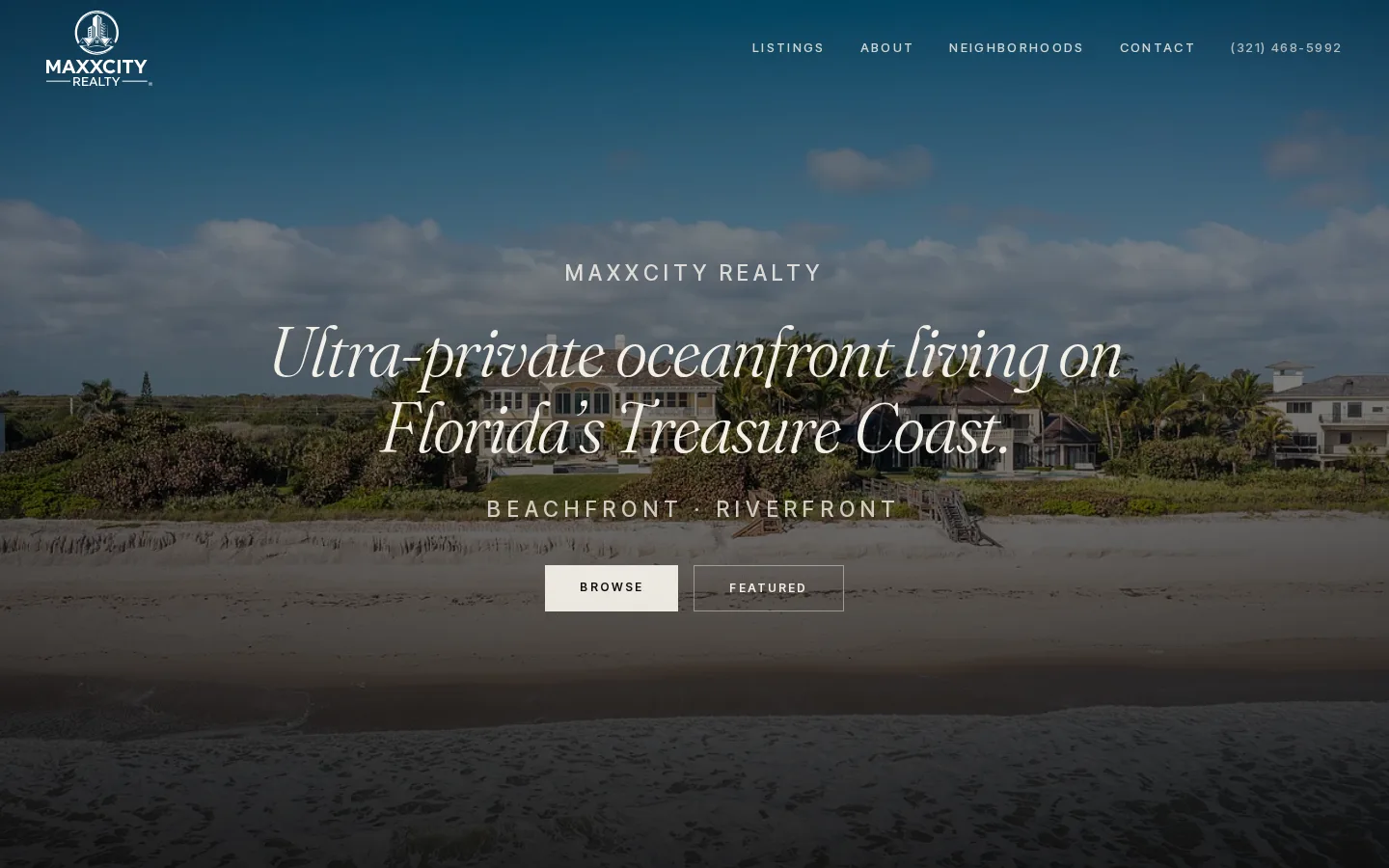
The point is not the specific brokerage. It is that an independent firm can own a marketing system that reads as premium as anything a national brand ships, without renting it from a platform that keeps the keys.
Frequently asked questions
What should a luxury real estate marketing agency include? A custom site you own, local SEO and content, fast tracked lead follow-up, review generation, and reporting you can actually read. The website is the foundation; the monthly work is what compounds.
How much does a luxury real estate marketing agency cost? It ranges widely, from low monthly template platforms to full custom builds with ongoing management. The number matters less than what you own at the end. A cheap site you rent can cost more over three years than a custom one you keep.
Do I need IDX to compete with national franchises? On-domain property search helps, but it is not the whole game. Owned local authority, submarket content, and fast follow-up often move more business than a search widget, especially in a specific luxury market.
What should be in a real estate marketing agency contract? Clear ownership of the site, domain, CRM, and leads; published scope and pricing; a defined monthly deliverable; and a clean exit. If any of those four is vague, get it in writing before you sign.
Key takeaway: The best luxury real estate marketing agency for you is the one that hands you an asset you own, publishes its pricing, invites you to verify its work, reviews the compliance no one else thinks about, and runs a real system every month. Ask the six questions before you sign, and let the answers decide.
If you run a brokerage or a team, see how we build for real estate.
See What Your Site Is Quietly Costing You
Fifteen minutes, and we will walk your site the way this post describes: where your leads land, how fast they get a response, and where buyers leak off to the portals.
Get the free guideRelated Industries