How a Custom Real Estate Website Replaced WordPress and Dominated Melbourne Local Search
MaxxCity Realty's custom Next.js site replaced WordPress with property search, Brevard County neighborhood guides, and a local SEO overhaul targeting Melbourne and Space Coast FL.
When a homebuyer searches "luxury oceanfront homes Melbourne FL" or "real estate Melbourne Brevard County," they're looking for a brokerage that knows the specific market. MaxxCity Realty understood this better than most—Bruce, the owner, has a software engineering background and knew a premium website wasn't a luxury, it was table stakes.
Their old WordPress site didn't reflect that. No property search. Poor performance. Geo-targeting said "South Florida" instead of Space Coast. Zero Google reviews. It was costing them—luxury clients expect a site that performs as well as the homes it showcases.
What Changed: From Template to Custom Build
NovraScale rebuilt MaxxCity Realty as a hand-coded Next.js site on Cloudflare Workers — no plugin ecosystem, no theme, no MLS widget bloat. Shipped in four weeks. Here is what the build included:
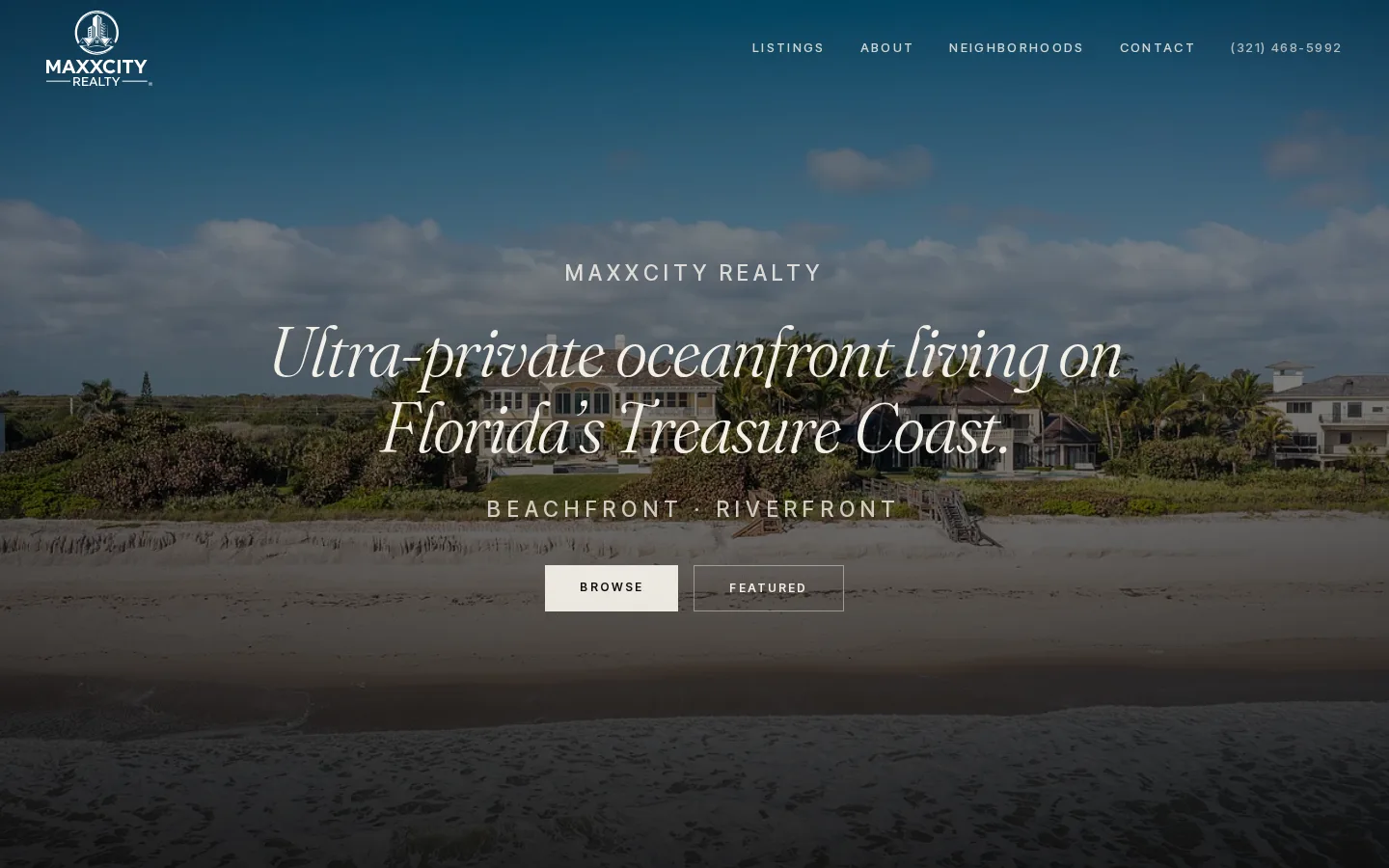
- Property search and filtering. Buyers can narrow by price range, square footage, community type, waterfront status. The search is fast and precise—no waiting for page reloads.
- Listing pages built for luxury positioning. High-res photography, detailed neighborhood context, buyer psychology copy. Each property gets its own conversation, not a database dump.
- Neighborhood guides for the communities MaxxCity serves. Not generic real estate content. Specific guides to Melbourne Beach, Indian Harbour Beach, and the barrier-island communities around Vero Beach, including Orchid Island in Indian River County. Each guide ranks for its own local search terms.
- Agent profile pages. Trust signal. Buyers want to know who they're working with before they call.
- Home valuation form. Lead capture for sellers. Converts cold traffic into warm prospects.
- Review acquisition system. Google reviews matter in real estate. The site funnels clients into requesting reviews, building social proof at scale.
None of this came from a theme. Every component—navigation, search, image optimization, loading states—was hand-coded to match MaxxCity's brand and user needs.
The Real Estate SEO Rewrite
The old site had a geo-targeting problem. It said "South Florida" and served searches for Miami, Tampa, Boca Raton. MaxxCity's actual clients live along the Space Coast and Treasure Coast: Melbourne and the Brevard County beaches, down to Vero Beach and Orchid Island in Indian River County.
The new site is built for that specific market:
- Neighborhood guide pages target "luxury homes in [specific community]" + "[community] real estate" searches.
- Property listing pages are optimized for "oceanfront homes Melbourne," "luxury beachfront property Orchid Island," and similar high-intent searches.
- Meta descriptions, headings, and schema markup all reflect local geography—Brevard County context appears in every relevant page.
- The blog can now rank for "Melbourne real estate market trends" and similar informational queries that position MaxxCity as the local expert.
The speed upgrade adds to the SEO advantage. A hand-built site on Cloudflare Workers renders faster than the plugin-heavy WordPress build it replaced, and Google's Core Web Vitals algorithms reward fast pages. Fast sites also reduce bounce rates when buyers are researching properties, which matters in a market where the buyer makes split-second decisions about whether to call.
Why Luxury Real Estate Demands Hand-Coded, Not Template
Template builders (Squarespace, Wix, WordPress themes) treat all real estate sites the same. Luxury markets demand a different approach:
- Photography is the hero, not an afterthought. Luxury homes sell on image quality and careful composition. A template's image handling is generic. MaxxCity's site optimizes every listing photo for speed and visual impact—WebP formats, responsive sizing, lazy loading that doesn't choke the initial paint.
- Buyers expect technical polish as a trust signal. If the website feels sluggish, the buyer assumes the brokerage is sluggish. Bruce's engineering background meant he understood this immediately. He got a site that felt as premium as the properties.
- Seller positioning matters more than buyer positioning. Most real estate sites chase buyer searches. MaxxCity's home valuation form and neighborhood guides also target sellers considering selling—a higher-lifetime-value audience.
- Hand-coded beats plugin bloat. Bruce wanted a site that would not slow down every time a plugin updated. A hand-coded build on Cloudflare Workers gives him listings that render fast and a stack that does not decay between releases.
A Foundation You Can Verify Yourself
You do not have to take our word for the technical quality. Run the live domain through Google's PageSpeed Insights and read the results yourself. The build is engineered to pass the automated checks Google runs before it ranks a page:
- Fast by construction. A hand-coded site on Cloudflare's edge network, with image optimization and no plugin bloat. Desktop pages render quickly; mobile performance is an ongoing optimization. Check the current scores yourself in PageSpeed Insights.
- Accessibility built in. Semantic markup, labeled controls, and keyboard-reachable navigation pass Google's automated accessibility checks. Automated scoring is one signal, not a substitute for a full WCAG audit.
- SEO foundation in place. The technical basics Google checks before it ranks a page: a sitemap, structured data, mobile-friendliness, and clean indexable URLs.
- Modern best practices. A current security posture and modern web standards, the trust signals Google verifies before it surfaces a site.
These checks are the difference between a site that loads before a buyer loses patience and one that does not. On this tier, that gap is measured in buyers who never reach the listing.
What Made This Work
MaxxCity Realty succeeded because the client understood the problem. Bruce knew a WordPress template wasn't going to compete in luxury real estate. He also knew that owning the ability to manage listings himself mattered—he didn't want to pay a designer every time he had a new property to add.
That clarity made the build faster and more focused. Instead of debating feature creep, every decision centered on: "Does this help sell homes or does it slow the site down?"
The result is a site that performs like a luxury brand—fast, intuitive, locally authoritative, and managed entirely by the business owner without technical overhead.
Key takeaway: Real estate sites that compete on local search need three things: geo-specific content and SEO, hand-coded performance, and a CMS the owner can manage without code. Template builders fail at all three. A custom build built for your market wins.
Is Your Real Estate Website Costing You Inquiries?
We'll audit your site's SEO positioning, search visibility, and conversion paths, so you know exactly where you're losing buyers and sellers.
Get Your Free Report CardRelated Industries