Best Mental Health Website Design in 2026: What Actually Works
What separates a mental health site that fills a caseload from a template, shown across two real practice rebuilds, not stock examples.
The best mental health website design is not a color palette or a template. It is a small set of structural decisions: how a patient finds the right clinician, how much a form asks before it asks for trust, and whether the site can be found at all against Psychology Today and the directory sites. We have built two live mental health practice sites this year, a 30-year multi-clinician team and a solo telehealth practice, and the same handful of choices separated a working site from a template on both.
Two practices, two different problems
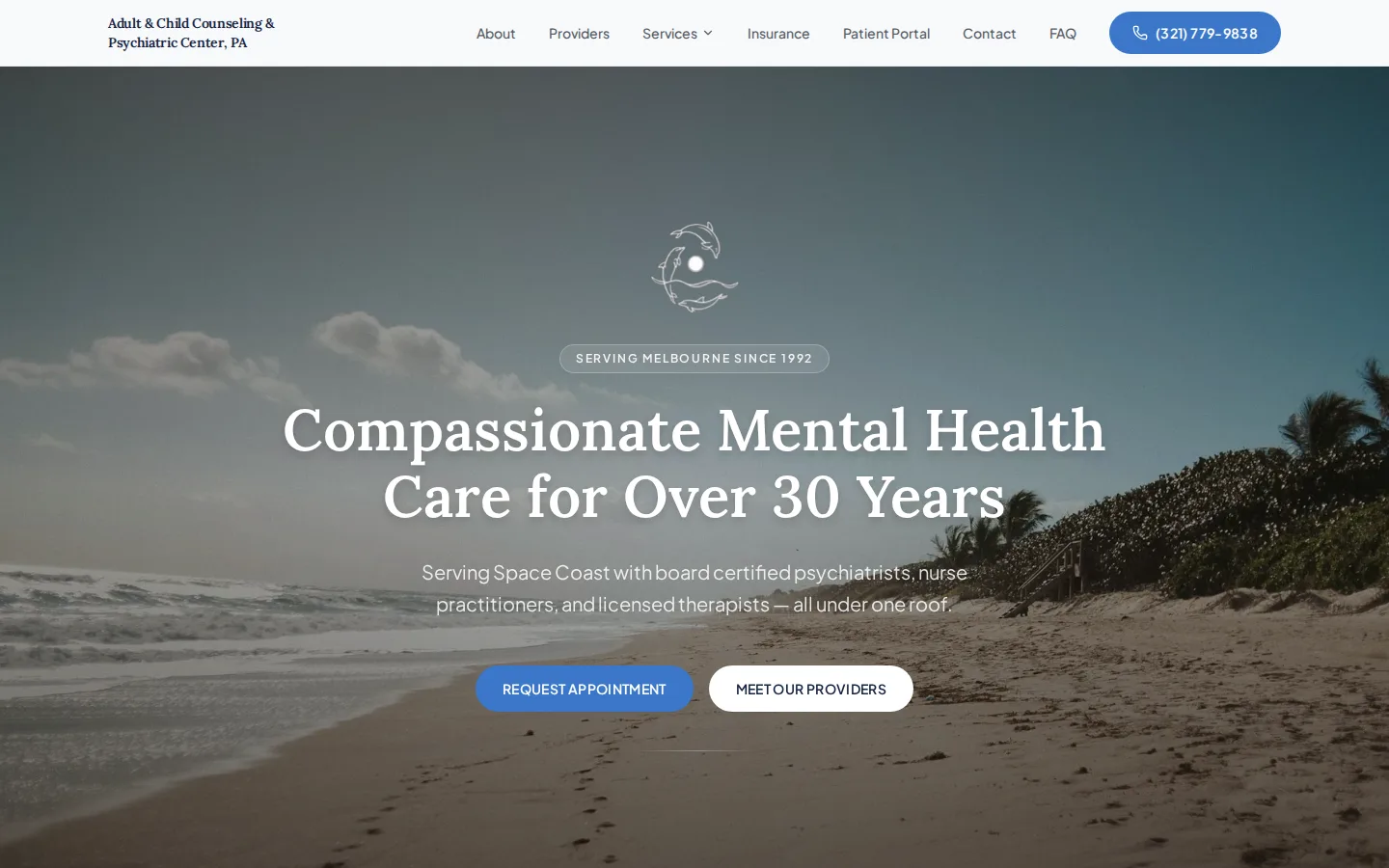
Adult & Child Counseling and Psychiatric Center (ACCPC) is a 33-year-old multi-clinician team in Melbourne, Florida: psychiatrists, nurse practitioners, and licensed therapists under one roof. Their old site scored 28 out of 100 on a technical audit and buried the entire team behind one undifferentiated bio page. New Leaf Mental Health is the opposite shape: a single psychiatric nurse practitioner, Emily Light, PMHNP-BC, running a telehealth practice across Florida with no office a patient would ever see and no local SEO presence at all.
Different practices, same underlying question: what does this website need to do in the first ten seconds that a template cannot?
A provider directory a referral can actually navigate
A multi-clinician practice that lists every clinician on one undifferentiated page makes a new patient guess who treats what. A referring physician has even less patience for it. ACCPC now groups its team by role, psychiatrists, nurse practitioners, licensed therapists, so a self-referring patient or a referring clinician finds the right fit in one look. A solo practice does not need this structure. It needs the opposite: one clear, credentialed person the patient can trust before they ever get on a call.
A page for every concern, not one generic services list
New Leaf treats patients across Florida for psychiatric medication management, individual therapy, and evaluation services for children, adolescents, and adults. A generic "services" page that lists all three in one paragraph loses a search for any specific one of them. A page built around "PMHNP medication management" or "psychiatric evaluation online" lands the exact patient who typed that phrase on the page that answers it, instead of a general homepage they have to keep reading to confirm fits their situation.
No free-text intake field on a covered entity's site
Neither ACCPC nor New Leaf collects anything through a form. There is no form, no input field, and no user account anywhere on either site. Every path a prospective patient can take ends at a phone number or at a system the practice already holds a BAA with. That is the whole control: not a safer form, no form. We wrote the fuller version of this, including what changes when a practice does want a form, at our BAA policy page, and the related question of what analytics tool is actually safe to run on a practice site at is Google Analytics HIPAA safe.
Local SEO that beats the directories, not just competitors
Psychology Today and the major therapist directories hold most of the first page for a "therapist near me" search. A practice with no independent local SEO is renting its own patients back from a directory it does not control. New Leaf had no Google Business Profile at all before the rebuild. ACCPC's Google Business Profile carried the wrong categories. Fixing both, correct primary category, consistent name and address and phone, service-area content for every condition treated, is what actually moves a practice above the directory listings, not a nicer homepage.
Fast, warm, and built to book
Someone reaching out about therapy or psychiatric care is already deciding whether to trust a stranger. A cold multi-field form with no warmth is one more wall, and they close the tab and try the next name on the list. New Leaf was built so a patient could move from landing on the site to booking an appointment in under 90 seconds: credential line first, plain-language explanation of what PMHNP-BC means second, and one clear next step, not a wall of forms upfront. ACCPC's rebuild moved from a 28 out of 100 technical audit score to 87 out of 100, with new patients inquiring within two weeks of launch.
What we did not include, and why
We are not going to rank competitor agencies against each other here. We do not have the standing to judge someone else's client work, and a list of ten agencies swapped by city name is exactly the kind of thin, interchangeable page Google has spent the last two years demoting. What we can show honestly is our own work: two real practices, live today, built for two different shapes of the same problem.
Frequently asked questions
What makes a mental health website design good?
Three things, in order: a patient can find the right clinician or confirm the right fit in one look, the first ask is small and warm rather than a wall of clinical fields, and the practice actually ranks for the searches that convert instead of relying on Psychology Today to send patients. Everything else, color palette, animation, stock photography, is decoration on top of those three.
Does a multi-clinician practice need a different site than a solo practice?
Yes. A multi-clinician team needs a provider directory grouped by specialty so a referral or a self-referring patient can navigate the team. A solo practice needs the opposite: one clear, credentialed trust story, since there is no team to sort through, only one clinician the patient has to decide to trust.
Is a mental health website itself subject to HIPAA?
The marketing site itself is not automatically in scope. What matters is whether it creates, receives, maintains, or transmits protected health information. On both of our live mental health builds it does not, because there is no form and no input field anywhere on either site, and every clinical path routes to a system the practice already holds a BAA with. Whether that arrangement fits your practice's own workflows is a determination for you and your counsel, not us. Full detail on the architecture is at /baa.
How much does a mental health practice website cost?
Mental health practice technology through NovraScale runs on one published monthly with a one-time activation at signing, covering the practice site, provider directory or single-practitioner build, service pages, EHR or scheduler integration, local SEO, and monthly reporting. Current pricing is on the mental health practice page.
How fast does a mental health practice site actually launch?
Both ACCPC and New Leaf launched inside 28 days of assets received: provider directory or single-practitioner build, service pages for every offering, EHR integration, local SEO, and testing.
The pattern: a good mental health website is not a nicer version of a bad one. It is built around who actually needs to find the right clinician fast, what a patient will and will not fill out before they trust you, and whether the practice shows up anywhere Psychology Today does not already own.
Not Sure What Your Practice Site Is Missing?
Book a free 15-minute call and we'll walk through what separates a site that fills a caseload from one that doesn't, specific to your practice.
Book a 15-Minute CallIf you run a practice in this space, see how we build for Mental Health Practices.
Related Industries